The Revisions Were the Story
Consumers kept saying the economy felt bad. Economists called it a vibecession. Then the hard data changed — hard.
By Baron Mulberry
For years, consumers kept saying the economy felt bad. Confidence surveys kept weakening. Households complained about unaffordable necessities, poor job prospects, and deteriorating finances.
Economists called it a vibecession. They said the feelings were wrong because the “hard data” showed a resilient consumer.
Then the hard data changed. And it changed hard.
The confessions
Benchmark revisions erased about 5% from the estimated level of retail sales — going all the way back to 2022. And that was on top of major downward revisions the previous year. Spending that authorities said had happened largely hadn't — not at anything close to the initially reported degree. After adjusting for price changes, consumers had received far less real merchandise than the nominal dollar figures implied. They were paying more — a lot more — while getting less. A lot less.
Consumers understood this immediately. They saw it in their shopping carts, in their bank accounts, on their credit card statements. The official statistics took years to catch up.
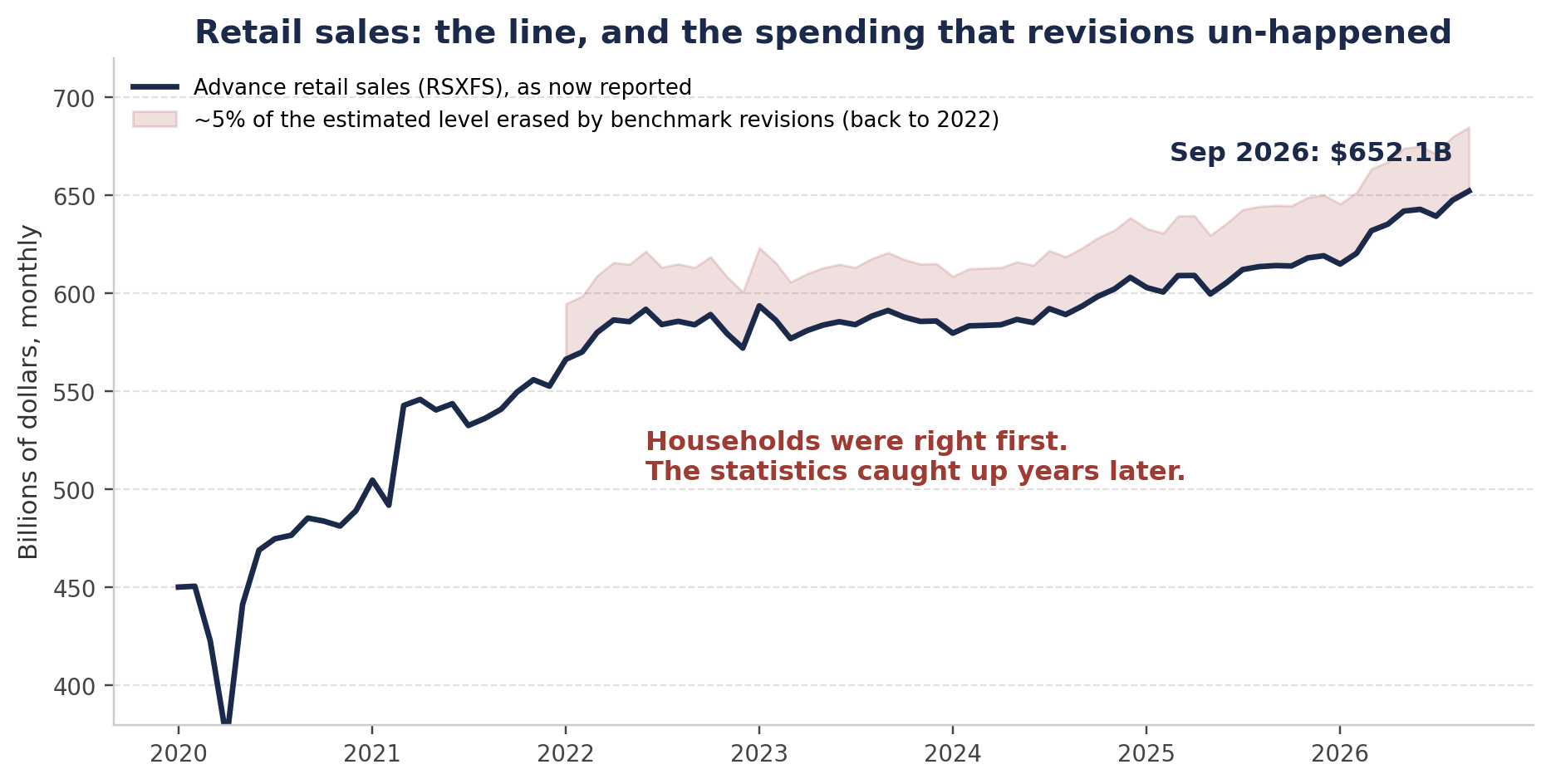
Chart 1 — Advance retail sales (FRED RSXFS), monthly, 2020 to September 2026 (September 2026: $652.1B), with a shaded band showing the ~5% of the estimated level, back to 2022, that benchmark revisions erased — as reported in the source transcript; the band is an illustration of that reported figure, not a separate series. Source: FRED (RSXFS).
Payrolls told the same story. The establishment survey — supposedly the strongest part of the economy — was repeatedly revised lower, with benchmark revisions covering 2024 and 2025 eliminating huge amounts of previously reported employment. The labor market looked stronger in the initial data than it actually was.
The vibes were the data all along.
Why it matters for housing
Here's the mistake being repeated right now in housing: treating first-print jobs data as proof of willing buyers.
Economists looked at the jobs numbers as initially released and saw possible homebuyers held back by rates or something temporary. The revised jobs data proved they were never going to be buyers in the first place. And so they weren't.
A household doesn't experience the economy as a national aggregate. A national payroll estimate doesn't make someone confident if hiring in their industry has disappeared. An average income figure doesn't help a household whose hours got cut or whose expenses rose faster than their pay. Households experience the economy individually — and individually, the jobs data was never as strong as everyone believed.
The latest signal on where households actually stand: consumer sentiment at 46.3 — near the all-time low. That's not a vibe. That's a measurement, and it's sitting at the floor.
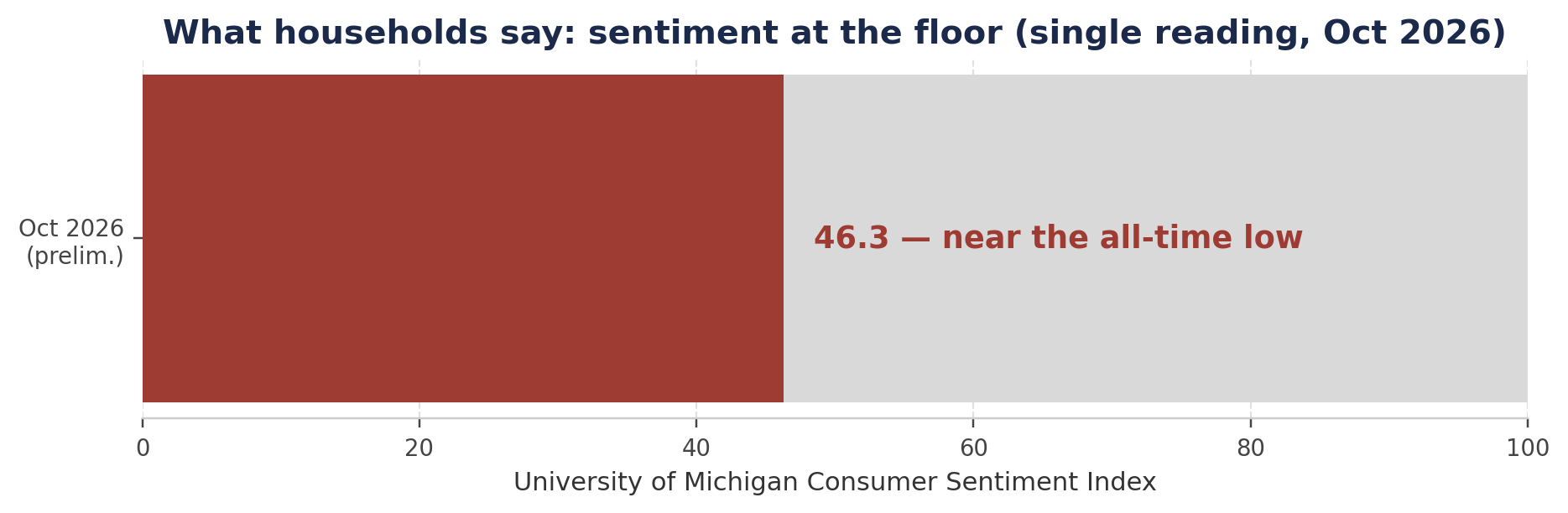
Chart 2 — University of Michigan consumer sentiment, October 2026 preliminary reading: 46.3, near the all-time low. Single reading only — no monthly series is plotted. Source: UMich print via the Friday tape (Oct 16, 2026).
The labor market behind the curtain
Even the most optimistic reads are sagging. Job openings fell by 256,000 in August to roughly 7.1 million — openings are the hopeful number, and it's fading. Hiring, the more important number, sat around 5.2 million, essentially unchanged from July's already depressed level. And quits stayed low — workers quit when they believe better jobs are out there; they stay put when they don't trust the labor market. Employed Americans don't see attractive opportunities anywhere else. Unemployed workers struggle to find anything at all.
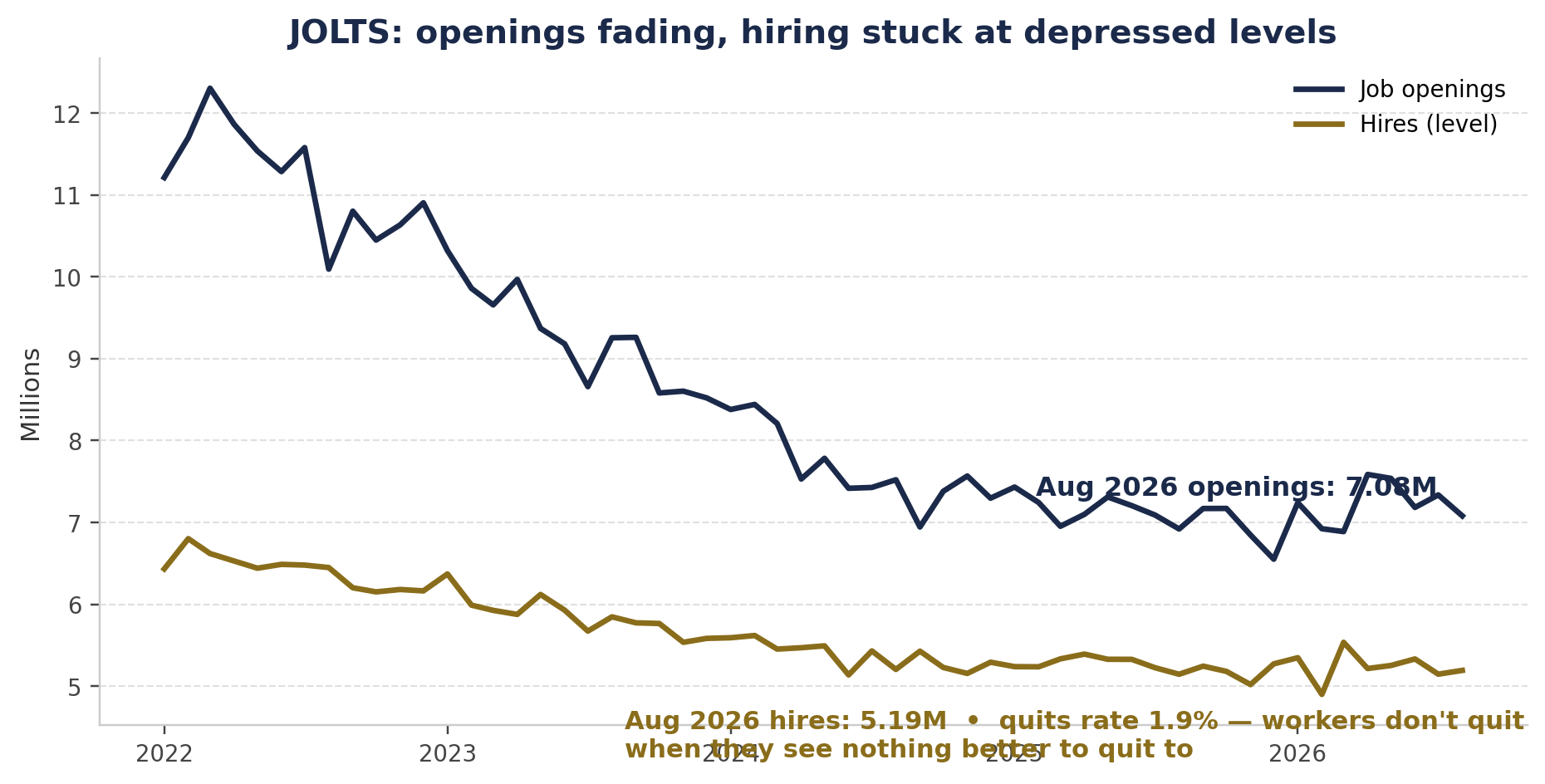
Chart 3 — Job openings and hires, monthly, 2022 to August 2026. August 2026: openings 7.079M, hires 5.192M; quits rate 1.9%. Source: Bureau of Labor Statistics JOLTS via FRED (JTSJOL, JTSHIL, JTSQUR).
Consumers don't need to be unemployed to go defensive. They only need to hear that their company is cutting costs, that orders are slowing, that coworkers aren't being replaced, that friends are taking months to find work. They respond before layoffs show up in the unemployment rate — if they ever do. They delay replacing the vehicle. They reduce credit card use. And they absolutely do not sign a 30-year mortgage unless they feel secure enough to carry it.
The operator read
The rule from here: trust what households do, not what first-print aggregates say.
Watch pending sales (66.0 — record low), buyer traffic (lowest since the pandemic), builder price cuts (43%), and price-cut depth in your own market. Those are actions. Aggregates are announcements, and announcements get revised.
The retail and payroll revisions are the precedent: the official numbers kept confessing later. In housing, the confession is still being written — in missing contracts, empty model homes, and listings aging on the market. You don't need to predict the revision. You just need to position for the pattern: resources ready, patience intact, and buy when the data finally forces the re-anchor.
Sources
Retail sales benchmark revisions (~5% of the level erased back to 2022, plus prior-year downward revisions) and payroll benchmark revisions (2024–2025 employment revised down heavily) — as reported in the source transcript (Oct 20, 2026); presented as reported, no invented precision beyond the ~5% figure given there. Consumer sentiment 46.3 (preliminary) — October 2026 UMich print (Friday tape, Oct 16, 2026). JOLTS: openings -256K to ~7.1M, hiring ~5.2M — transcript figures; openings verified against FRED JTSJOL (7.079M Aug 2026) and hires level against FRED JTSHIL (5.192M Aug 2026), CSVs downloaded Oct 20, 2026. Quits rate low — transcript-reported (FRED JTSQUR: 1.9% Aug 2026). Nominal retail sales series: FRED RSXFS (CSV; Sep 2026: $652.1B).