Lower Rates Won't Rescue This
The industry has spent years waiting for lower rates to save it. Rates fell along the way. Sales never meaningfully recovered.
By Baron Mulberry
The housing industry has spent years waiting for lower rates to save it. Lower rates, the story goes, unlock the buyers, restart the volume, revive the market.
They've been telling us that for years. Rates fell at points along the way. Sales never meaningfully recovered. That's the part they never bring up — because it blows up the whole story.
The falsification test
If the rates-only story were true, it would be testable: when rates decline, sales should recover. They didn't.
Rates have moved both ways during this housing depression. When they declined, buyers didn't come back — even though the industry's economists told us they would. A theory that fails its own prediction isn't a theory anymore. It's a hope wearing a chart.
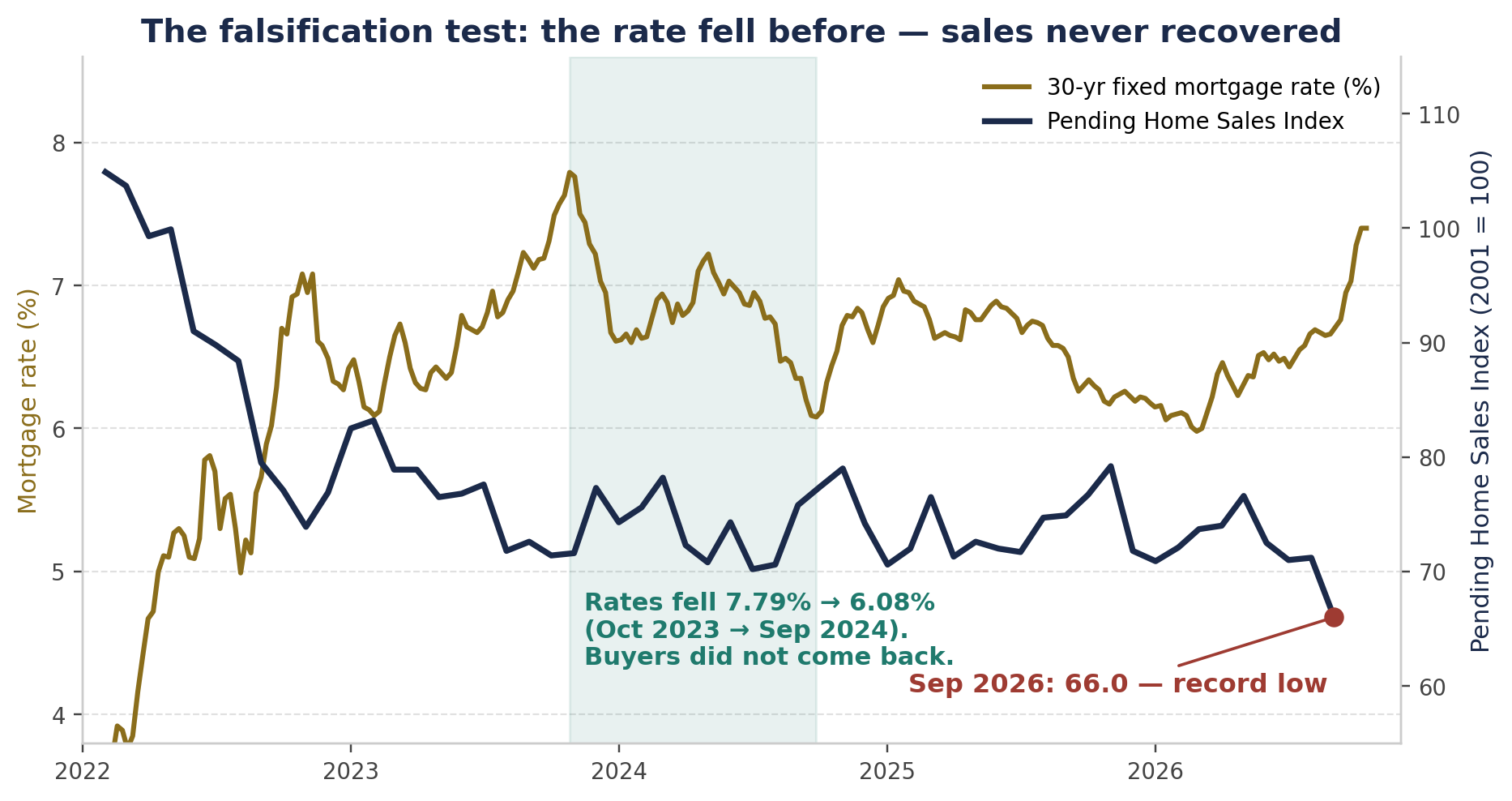
Chart 1 — The falsification test, 2022 to October 2026: the 30-year fixed mortgage rate (weekly, Freddie Mac via FRED MORTGAGE30US) against the Pending Home Sales Index (NAR, as reported). Shaded window: the rate fell from 7.79% (week of Oct 26, 2023) to 6.08% (week of Sep 26, 2024); pending went 71.4 (Oct 2023) to 75.8 (Sep 2024) and then reversed to 66.0 by September 2026 — no sustained recovery. Current rate: 7.40% (weeks of Oct 8 and Oct 15, 2026). Sources: FRED (MORTGAGE30US); NAR pending index as reported.
Affordability was never just the rate. Affordability is price × payment × income — and the binding term is confidence in future income. A household can calculate today's mortgage payment. What it can't know is whether one or both earners will still have their jobs two years from now. That uncertainty changes everything.
Why cheaper money arrives with weaker jobs
Here's the part the rate-watchers skip: rates frequently decline because markets expect slower growth. That's the Treasury market doing its job — expecting weaker inflation, weaker activity, and eventual Fed cuts to recognize it.
So the mortgage rate and the labor market don't move independently. They arrive holding hands. In that environment, the monthly payment improves while the perceived risk of unemployment rises. For a buyer, saving a few hundred dollars a month doesn't compensate for the possibility of losing an entire paycheck.
A household that expects stable employment may tolerate a higher rate — especially if it believes refinancing will eventually be available. A household that distrusts the labor market won't make a 30-year commitment at almost any rate. The 30-year fixed is at 7.40% — near a three-year high — and yes, that's pressure. But the pressure was never only the payment. It was the payment sitting on top of job anxiety.
The industry's incentive problem
Realtor organizations have every incentive to frame the problem as temporary. Their business depends on transactions. Saying “buyers and sellers are merely waiting for favorable rates” sounds a hell of a lot better than admitting the consumer base is losing confidence in future income.
But pending sales have fallen below 2008. Starts and permits are declining. Builder confidence is at a 14-year low. Buyer traffic is near pandemic levels. Existing home sales are under 4 million annualized. Those aren't separate stories — they're multiple parts of the same system responding to the same macroeconomic weakness.
Lower rates, if they come, arrive as a symptom of the disease, not the cure. The industry keeps prescribing the symptom as the treatment.
The operator read
Do not underwrite a rate rescue. Underwrite price and time.
If mortgage rates fall because the economy weakens, you get cheaper payments attached to scarcer paychecks — and sellers who finally have to face the bid. That's not a rescue. That's the adjustment arriving through a different door: price, capitulation, time.
The play stays what it was: resources first, opportunities always print. Keep the reserves, keep the labor in-house, keep the credit lines warm. Watch the cuts deepen and the anchors drag. When the general population finally accepts that 7% is just what money costs now — not a storm to wait out — volume unlocks and the deals print. You don't need rates to save housing. You need sellers to meet reality. That's the whole trade, and it's the one you've been running since 2010.
Sources
30-year fixed mortgage rate 7.40% (weeks of Oct 8 and Oct 15, 2026) — verified against FRED MORTGAGE30US (CSV downloaded Oct 20, 2026). Pending home sales 66.0 (record low since 2001) — NAR September 2026 release (Tuesday tape addendum, Oct 20, 2026). Housing starts 1.221M / single-family 859K / permits in line — Census/HUD September 2026 (Tuesday tape, Oct 20, 2026). NAHB index 29 (14-year low), traffic lowest since pandemic onset — NAHB October 2026 release via the source transcript. Existing sales under 4M annualized — FRED EXHOSLUSM495S (3.93M Aug / 3.99M Sep 2026). The “rates fell, sales didn't recover” falsification argument — the user's source transcript (Oct 20, 2026), Snider-style institutional read rebuilt in BlueCollarQuant voice.
Baron Mulberry writes as BlueCollarQuant — blue-collar operator, quant thinking. Real assets, real cycles, no fluff.