A Deregistration Is Not a Death Certificate
The media don't just lie with numbers. They lie with definitions first.
By Baron Mulberry
Here is a headline making the rounds in Argentina: almost 32,300 companies have closed since the Milei government began. Ninety-four companies a month, destroyed. It sounds precise. It sounds sourced. It even comes with an official-sounding abbreviation behind it — the SRT.
There is only one problem. The indicator underneath that headline does not measure company closures. It never did. The number is real paperwork wearing a costume, and the costume is the whole story.
We love narrative but the data makes it empirical. So let's be empirical — starting with what the data actually is.
The headline counts exits. It calls them deaths.
The figure traces back to Argentina's Superintendencia de Riesgos del Trabajo — the SRT, the occupational-risk system. Think of it as the registry that tracks which employers have workers covered against workplace accidents and injuries. An employer shows up in that system because it declares people working under it. An employer leaves the count when it stops declaring them.
That is all the indicator measures: units declaring people inside a risk-insurance system. It is a headcount registry for workplace coverage. It is not a business registry, not a bankruptcy court, and not a coroner's office.
When an employer disappears from the SRT count, the headline writer sees a corpse. What the registry actually recorded is an exit — and exits have more than one cause:
- A real closure. Yes, this happens, and nobody serious denies it.
- A merger or acquisition. Two employers become one. The registry loses a unit; the economy did not lose a company — it consolidated one.
- A corporate reorganization. The same business, restructured under a new legal shell. The old unit vanishes from the count.
- A CUIT change. The CUIT is Argentina's tax ID. Change the number and the old registration ends while a new one begins — same firm, same workers, new paperwork.
- A drop to zero declared employees. A firm that stops declaring covered workers leaves the registry whether it shut its doors or simply changed how it operates. Add those five doors together and you get an exit count. Call every exit a destruction and you have manufactured thousands of dead companies out of reorganizations and tax-ID changes. That is not a rounding error. That is a category error — and category errors are how a true number becomes a false headline.
What the headline says vs. what the indicator measures
Read the right-hand column and the scandal evaporates. What remains is a registry doing registry things — and a media class that either didn't check what its own source measures, or checked and ran the headline anyway. For clicks, the second option works just as well as the first.
Now the honest mirror — because we aren't fact police for one side
Here is where this publication parts company with the cheerleaders. The rebuttal making the rounds — including a widely shared pro-government video — answers the death count with a birth count: 29,553 new companies created in 2024, a record 31,431 registered in 2025, and 7,862 more in the first four months of 2026 alone. More than 60,000 new companies in two years. Case closed, right?
No. Gross registrations are births, not net survival. A record number of births can happen in the same year as a record number of deaths — ask any maternity ward next to a cemetery. Showing only the entry side of the ledger is the exact same trick as showing only the exits, just with the jersey colors swapped. We don't run that play here, not even when it favors our side of the argument.
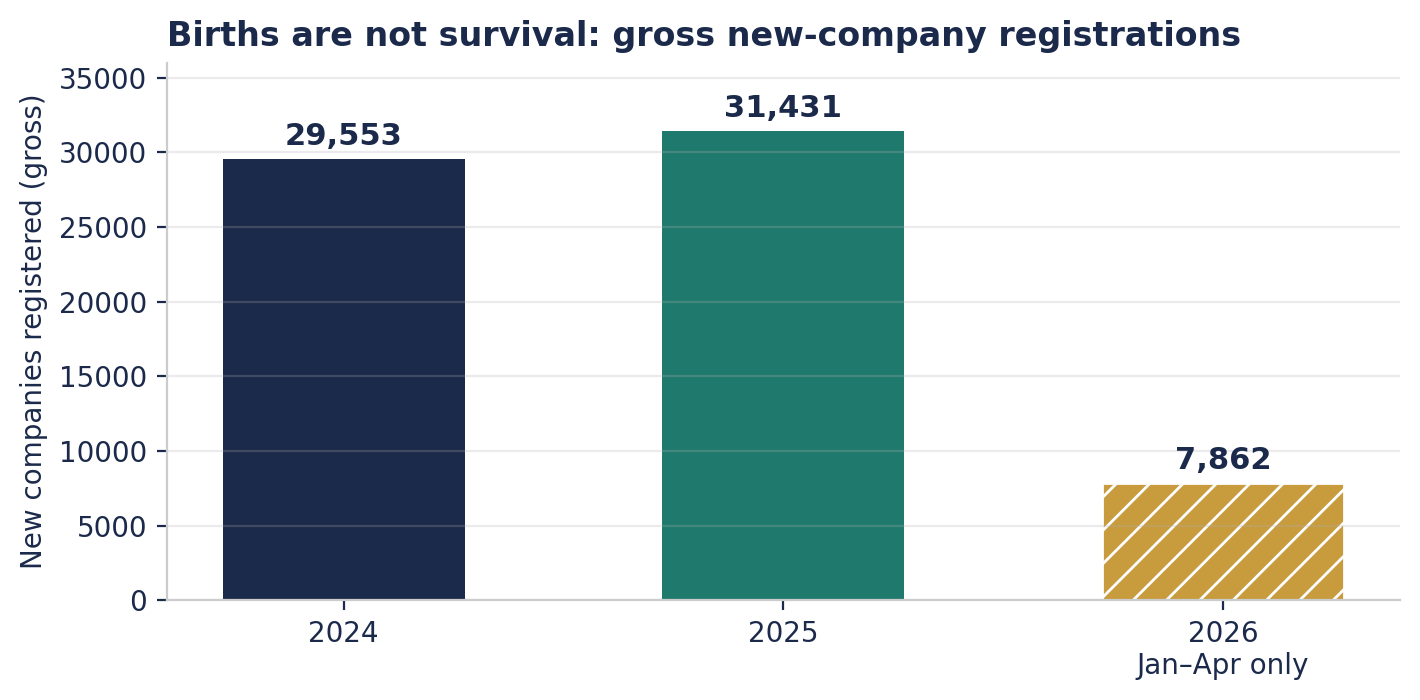
Gross new-company registrations as stated in the video cited in the text. Births, not net survival — the 2026 bar covers January–April only.
What actually decides the argument is unglamorous: net active employers and payroll employment, over the same window, under the same definition. Births minus deaths, on one ruler, for one period. Whoever brings that number wins the argument. Whoever brings only one side of the ledger is selling something.
Two job numbers can both be true — and that's the point
The same definition game runs through the employment fight. The video cites INDEC data showing total employment up by roughly 510,000, led by the private sector, with a significant reduction in the political and public sector — the part, the argument goes, that was destroying Argentina.
At the same time, critics point to registered private payroll and find it soft. Both sides then accuse the other of lying. Usually, neither is. They are holding different rulers:
- Total employment (INDEC's household survey, the EPH) — counts everyone working — formal, informal, self-employed, the monotributista fixing roofs and the shopkeeper's nephew stocking shelves.
- Registered employment (SIPA, the pension-system records) — counts only formal jobs on the books, the ones with contributions attached. A labor market can absolutely add half a million total jobs while formal payroll treads water — if the growth is self-employment, informal work, and people leaving the public payroll for the private economy. That is not a contradiction. That is a composition story, and the composition is the real story: who is hiring, who is shedding, and whether today's informal job becomes tomorrow's registered one. Anyone who quotes you a jobs number without telling you which population it counts is hoping you won't ask.
The same game, played with billions
If you think this only happens with registries and jobs, look at RIGI — the large-investment incentive regime at the center of Argentina's rebuild. Our own Source Check dossier pulled three numbers for the same program, and all three are defensible:
- $209 billion — the announced universe: every project declared under the regime's umbrella.
- $49.7 billion — the approved projects: what has actually cleared the gate.
- Under $1 billion — the money that had actually entered the country at the time of the check.
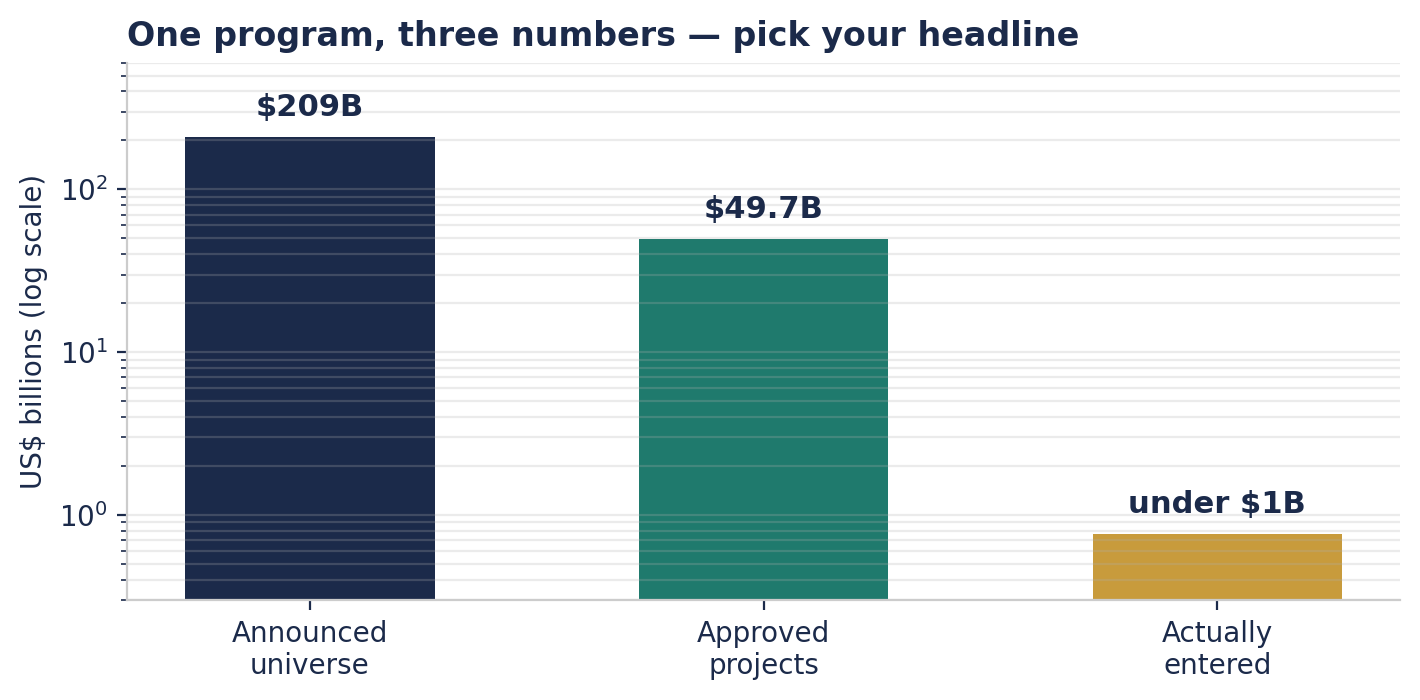
RIGI figures from the BlueCollarQuant Source Check dossier. Log scale — the gap between announced and entered is the story.
The government quotes the first number. The opposition quotes the third. A speaker in the video cited above quoted a fourth cut — $32 billion in committed investments — which sits somewhere in the same family of definitions. None of them is the program. Each is a slice of it, chosen because it fits the headline that was already written. Announced is not approved. Approved is not disbursed. Disbursed is not built. Four different moments in a pipeline, four different truths, one fight.
Why the definition always gets buried
Understand the incentives and the pattern stops looking like sloppiness. A deregistration is boring. A destruction is a headline. A gross birth count is bookkeeping; a record is a triumph. Nobody clicks on “registry churn consistent with reorganizations, net effect pending.” Nobody shares it, nobody funds a newsroom with it, and no campaign cuts an ad from it.
So the definition — the one sentence that tells you what the number actually is — gets buried under the number itself. This is the same machinery we have written about before: pick the ruler, and the headline writes itself. The underdog doesn't just fight in the economy. He fights over how the economy gets measured, against institutions whose categories were built for the old map and whose incentives point at the old winners.
None of this means the numbers are useless. It means the number is the last thing you should look at. The definition is the first.
The operator's rule
Mom-and-pop version, taped to the register, good in any country:
-
Before you repeat a number, ask what the indicator actually counts.
-
Stock or flow? A level at a moment, or movement over a period?
-
Gross or net? One side of the ledger, or both?
-
Deaths or paperwork? Something ended in the real world, or something changed in a registry?
A deregistration is not a death certificate. A registration is not a pulse. And a headline is not data until you've read the definition it is standing on.
A note on sources: company-registration and employment figures are as stated in the video supplied to BlueCollarQuant; RIGI figures are from our Source Check dossier. Where a figure comes from a speaker rather than an audited series, this article says so — that labeling is the whole point of the piece.