The Rocks Were Always There
By Baron Mulberry
Before he was a candidate, before he was president, Javier Milei was a professor. Three-hour cátedras. Theory first, sources on the table, no slogans without receipts. That is why operators listen to him differently: he teaches the mechanism, then he shows you the number.
This speech — delivered to the oil and gas industry in Patagonia — is the cleanest version of his whole argument. It is not really about oil. It is about the oldest fight in economics: the institution that lives off production, versus the mom-and-pops who actually produce.
We love narrative. But the data makes it empirical. So every claim below carries its chart.
The rocks were always there
Start where Milei starts: with energy itself. For almost all of human history, everything was produced by muscle — yours and your animals'. Income per person barely moved for thousands of years. Then, a little over two centuries ago, we learned to burn what nature had stored underground for millions of years, and the wealth curve finally bent upward.
Put it in kitchen-table units, the way he does: one barrel of oil holds the energy of years of human labor. Neuquén now produces more than 600,000 of those barrels every day. That is millions of years of work coming out of the ground daily — work no human back has to do. It runs the tractors, lights the hospitals, powers the factories, and now feeds the servers.
Here is the part that should embarrass every planner on Earth. Vaca Muerta is the second-largest shale gas formation in the world and the fourth-largest shale oil formation. Argentina sat on top of it for a decade — and ran it at half capacity. Suppressed prices. Currency controls. Fear of investing. Every winter, a country dying of thirst on the shore of a lake went out and bought ships of liquefied gas from abroad.
"A nation's wealth depends much more on its institutions than on its subsoil. The institutions that generate the greatest prosperity are those that defend life, liberty, and property."
— Javier Milei, Oil & Gas Patagonia 2026
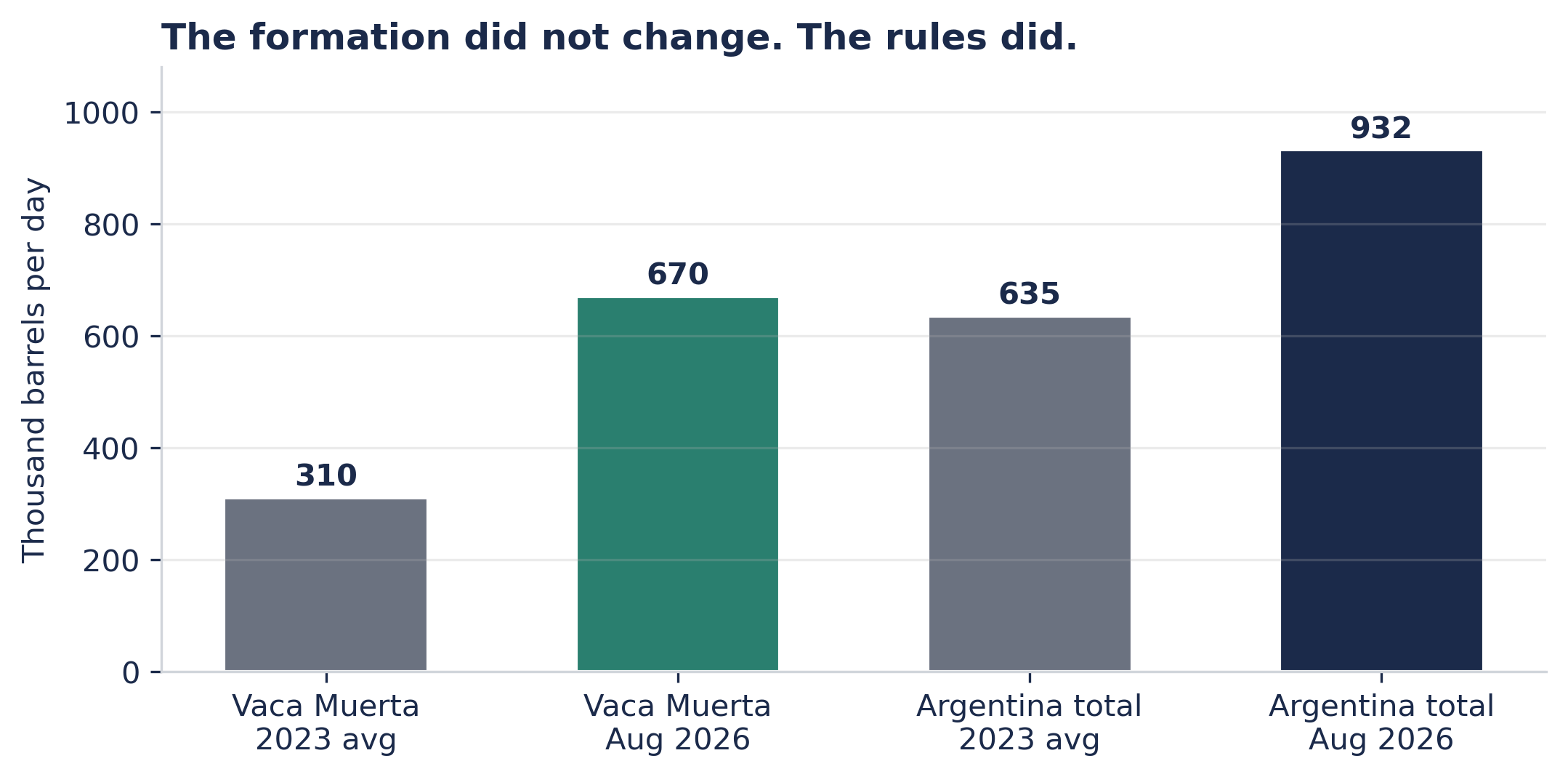
Nothing geological changed. No new rock was discovered. The formation was always there. What changed were the rules — and in less than three years, the same ground that could not supply its own country became a top-tier regional exporter. Exports averaged about 128,000 barrels a day in 2023. By July of this year, they hit almost 330,000 a day.
One decree moved more than a decade of speeches
The revolution started small, and Milei is honest about exactly where. Buried in Decree 70/23 — in his government's first week — was the elimination of the "criollo barrel": the controlled domestic oil price that told producers they would be paid less than their product was worth, by law, forever.
That one line is the whole theory in miniature. A price control is not a discount. It is a signal that says: do not invest here, because the state reserves the right to confiscate the upside. Remove the signal and capital does the rest — not because capital is patriotic, but because it can finally do arithmetic.
Then keep removing. By the end of this month, he says, Argentina will reach roughly 18,000 deregulations. Read that the mom-and-pop way: 18,000 separate moments where somebody in an office could stop you, charge you, delay you, or sell you permission to do what was already yours to do. Each one removed is a small pay raise for everyone who builds.
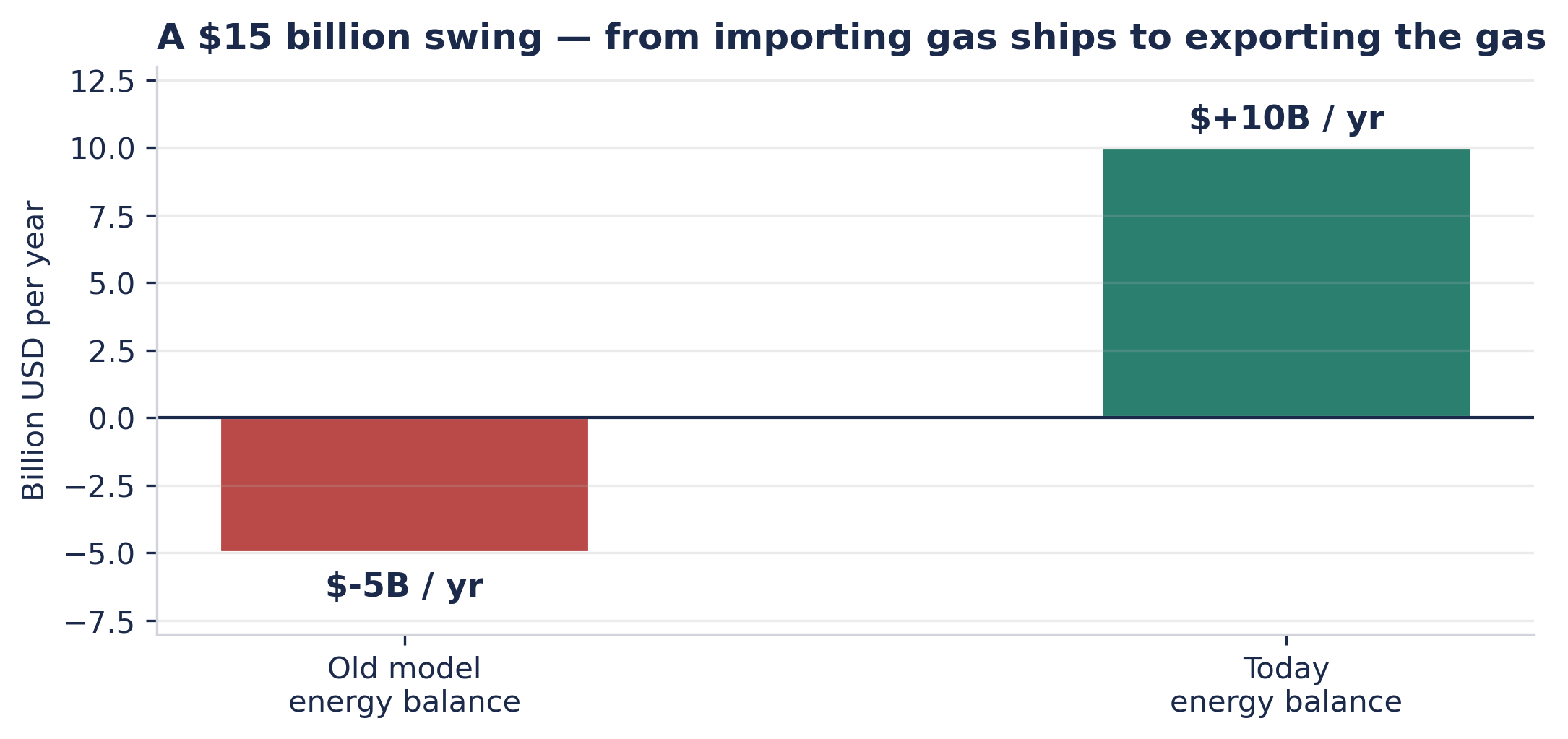
The scoreboard: an energy sector that bled billions a year now runs a surplus above $10 billion on the rolling 12-month count. The pipeline that used to bring Bolivian gas south has been reversed — Argentine gas now crosses Bolivia to reach Brazil, a sentence that would have sounded insane five years ago. The gas reaches Chile, Uruguay, and Brazil. Same rocks. Same workers. Different rules.
Inflation is the tax nobody voted for
Now the part the cátedra exists for. When Milei arrived, he says, inflation was running at 1.5% per day. Run that number yourself, because he insists you should: 1.5% daily compounds to roughly 56% in a month. Not the 13% or 25% his critics cite — fifty-six. Today it prints below 2% a month, with core inflation at 1.7%, roughly 20% annualized. Still not Switzerland. He says so himself. But it is the difference between a currency melting in your hand and a currency you can write a contract in.
(The honest footnote: that 1.5%-a-day derives from December 2023 wholesale prices — INDEC's IPIM rose 54% that month, about 1.45% a day compounded — and most of the wholesale jump followed the 13 December devaluation by his own government. Consumer inflation that month was 25.5%, about 0.76% a day. That is the attribution the critics stress. It is real. But it is a different number from the one he is quoting, and the direction of the move is not disputed.)
Why does a mom-and-pop care about a fiscal surplus? Because inflation is how the state taxes people it never has to ask. No vote, no receipt, no rate printed on a form — it just takes a slice of every paycheck, every savings account, every rental deposit, every week. The old model ran a deficit of five points of GDP and paid for it with the printing press. The new model produced a fiscal surplus in its first month and has held it as the anchor ever since.
His counterfactual is worth printing in full, because it is how operators should think about every government program. Argentina faces about $25 billion in debt maturities — which he says are secured. Under the old model, the Treasury would have needed another $35 billion for the deficit, plus an energy sector $20–25 billion in the hole: roughly $60 billion to find, in a panic, from a world that has been scammed by Argentina before. That is not a policy debate. That is hyperinflation and a GDP collapse of 10 to 15% — the old ending, one more time.
The discussion today is whether growth is decelerating and inflation falling slower than hoped. Sit with that. The argument is now about the speed of the recovery instead of the size of the explosion. The baseline moved.
You cannot tax a project that does not exist
The Large Investment Incentive Regime — the RIGI — is where Milei gets visibly angry, and the anger is pedagogical. Economists complain about RIGI's "fiscal cost": the taxes Argentina supposedly gives up to attract large projects. His answer is a question any shop owner could ask:
"How can an investment that would never have been made without RIGI have a fiscal cost? A project that doesn't exist pays no taxes. Even at 100%, one hundred percent of zero is still zero."
— Milei, on the RIGI debate
That is not a trick. It is the most ignored sentence in tax policy. Capital is mobile. It compares countries the way you compare suppliers. A project scared off by confiscatory, reversible rules does not pay a reduced tax rate somewhere in Argentina — it pays its taxes, hires its workers, and buys from its suppliers in Chile, or Texas, or nowhere.
The receipts, as he gives them: more than $210 billion in announced RIGI projects, 45% of them in oil and gas. The Argentina LNG project — YPF with Italy's ENI and the UAE's XRG — is a $51 billion investment, the largest in the country's history, worth up to 40,000 jobs and up to $10 billion a year in exports. The Vaca Muerta Sur pipeline, about $3 billion, unlocks roughly $15 billion a year in crude exports. Nine thousand kilometers of national highways handed to private operators. Consortia advancing royalties to build the roads they themselves need.
And the deeper point, the one that matters for anyone who has ever signed a 30-year anything: whoever puts up the capital needs to know the rules they start with are the rules they finish with. Credibility is not a mood. Credibility is built, in his words, by taking away the state's ability to backtrack. That is what RIGI actually is — not a giveaway, a lock. His stated endgame: the whole economy converges to RIGI conditions, not the other way around.
| The project | The scale (as stated) | What it proves |
|---|---|---|
| RIGI pipeline, all sectors | $210B+ announced; 45% oil & gas | Rules, locked, pull capital |
| Argentina LNG (YPF / ENI / XRG) | $51B; up to 40,000 jobs; ~$10B/yr exports | Largest investment in national history |
| Vaca Muerta Sur pipeline | ~$3B in; ~$15B/yr out | Private capital builds the infrastructure |
| National highways concessioned | 9,000 km to private operators | "Public works" was a story, not a law |
Same mountain, two countries
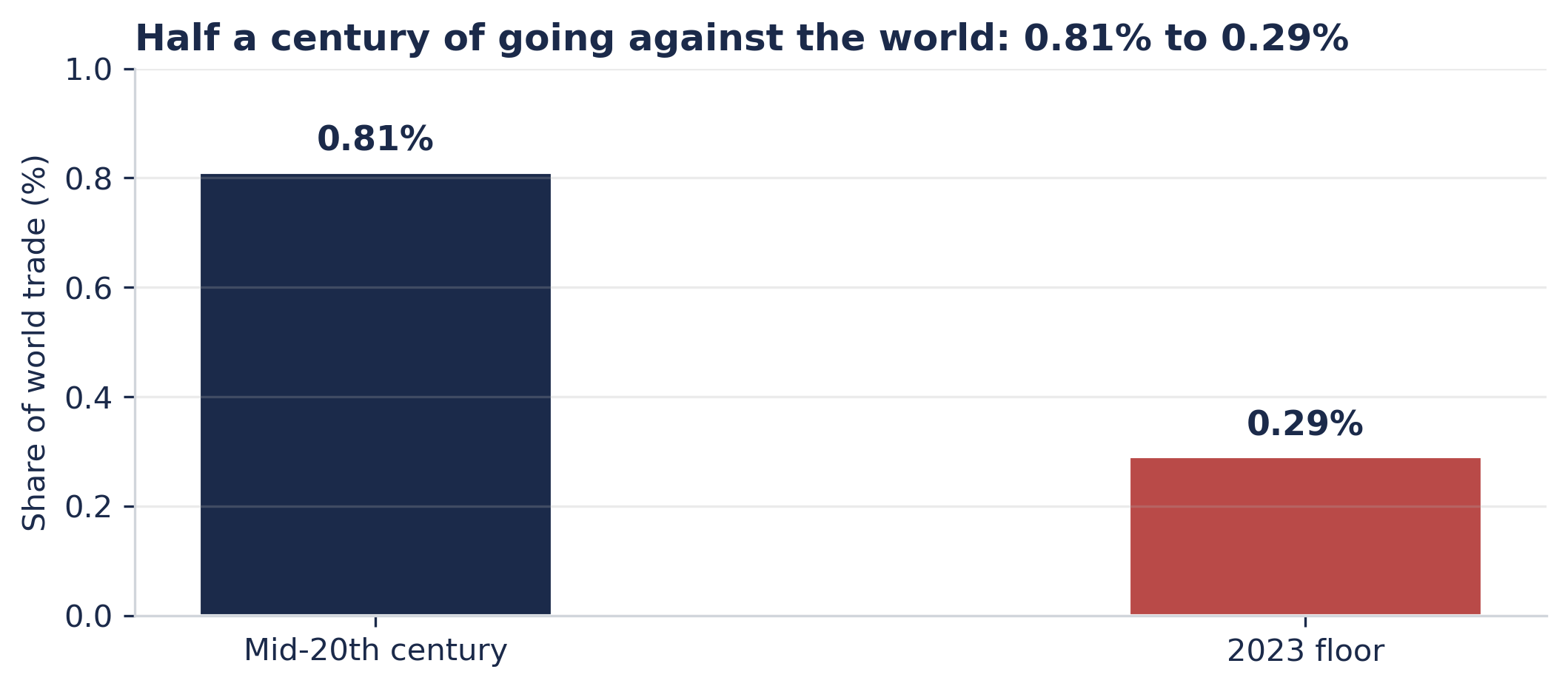
Here is where the cátedra turns controversial, and we will print it anyway, because the comparison is the argument. The whole social-democratic structure has the same flaws everywhere it is built — Milei's thesis is that Argentina is simply the place it ran longest and broke hardest. A century of it took Argentina from 0.81% of world trade to 0.29% in 2023. Over 2000–2025, Latin America multiplied its exports by 5.92. Argentina managed 2.78.
Chile shares Argentina's mountain range. Chile exports about $60 billion a year in mining. Argentina exported $4 to $5 billion in 2023–24 — and a record $6,037M in 2025. Same geology. The potential multiple is twelve to fifteen times — sitting there, unmined, behind permits, export taxes, and bans.
The cleanest experiment is inside Argentina itself. San Juan and La Rioja share the same range and the same minerals. San Juan joined RIGI: billions in copper projects, and a $600 million, nine-year Wall Street bond to build its own infrastructure. La Rioja refused: it issues scrip — the chachos — to pay its public employees. La Pampa, sitting in the geographic center of the country, a natural logistics hub between Patagonia, the north, the mountains, and the ports, chose to make itself, in his phrase, an enemy of growth. Crossing from one province to the next, he says, is like crossing the Berlin Wall.
That is not rhetoric. That is a controlled experiment running in real time, and every mom-and-pop in either province is living inside one side of it. Institutions are not abstract. They are the difference between a bond issue and printing your own pretend money to make payroll.
Nothing trickles down — both sides get paid
Milei pauses the speech to kill a phrase, and it is worth repeating exactly, because it cleans up how you should talk about every deal you ever do. There is no trickle-down theory in liberal economics. In a free agreement, a capitalist has nothing left over to "trickle": if he underpaid a worker or overcharged a customer, someone else would take the business with a better price. If anything moves, it moves both ways — buyer and seller both walk away better off, or the trade does not happen.
Then he does the exercise the critics skip. Forget the direct jobs for a moment — count what Vaca Muerta buys. The frac sand comes from Entre Ríos. The steel pipe is made in Campana. Metal shops, transport firms, and service companies across the country sell into Neuquén today. Rio Tinto, mining in the north, just allocated $1.8 billion to Argentine suppliers. A construction boom — homes, industrial parks, hotels, offices, restaurants — is remaking Neuquén at a speed the city has never seen. Cheap, abundant, local energy then lowers the cost of everything else: two of the world's largest urea plants are planned on Vaca Muerta gas, for a farm sector that currently imports its fertilizer.
That is not trickle-down. That is a supply chain — the same way one good rehab on your street lifts the bakery, the lumber yard, and the title company. The wealth effect is not a favor handed down from the top. It is what happens when production is finally allowed to compound.
The operator's read: rules are the asset
Strip the flags and the accents away and this is a speech for anyone who has ever held an asset through a bad government. Three lessons travel:
First, basis follows rules, not resources. The most valuable shale on Earth was a money-loser under price controls and a money-printer under free prices. Your doors work the same way. The house does not change when the regulation does — the value does. Underwrite the rules before you underwrite the property.
Second, credibility compounds. A surplus held month after month, contracts respected, a central bank cleaned up in six months — none of it is exciting, and all of it is the asset. It is why debt rolls over, why reserves get bought — more than $20 billion since the election, by his count — and why a country the world had written off now gets to choose its partners: the United States, Germany, Italy, instead of the old list he does not let anyone forget.
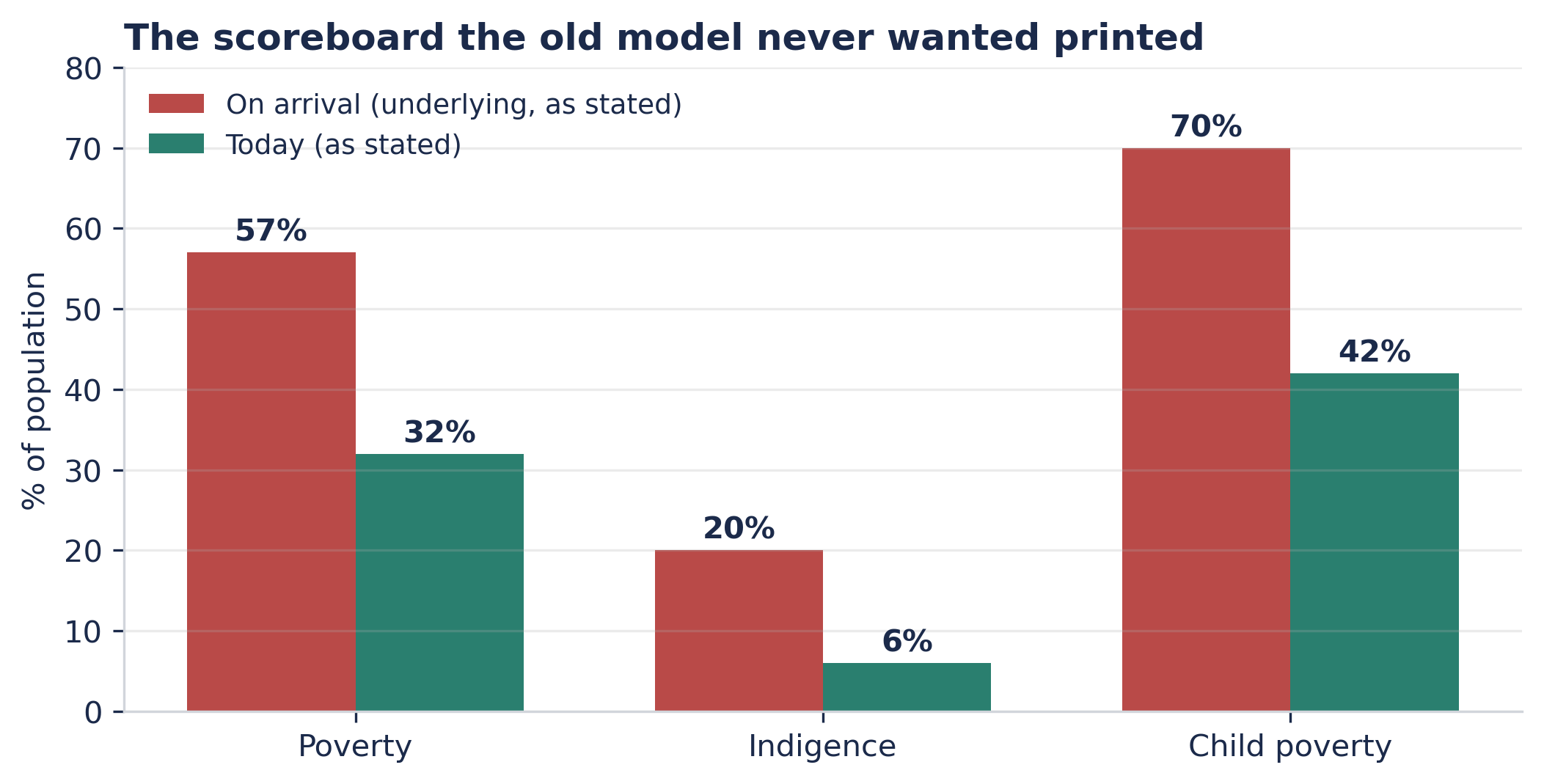
Third, the era of potential is a choice. Argentina was an expert at having potential: potential energy power while begging for gas ships, potential trading nation while ranking among the most closed economies on Earth, potential rich country while its poverty rate climbed toward the 57% underlying figure he inherited. Potential is what institutions produce when they punish production and call it compassion. Reality is what shows up when the punishment stops.
The vote next year, as he frames it, is the investor's test: the State Party in its polite and impolite versions, versus the model of freedom — the first time, he argues, Argentines get to choose with the alternative already running, measurable, and exporting. Twelve million people out of poverty on his numbers. Inflation from 56% a month to under 2%. A million barrels a day in sight.
The rocks were always there. They were there under every failed government too. That is the whole lesson, and it applies far beyond Neuquén: wealth is not what is under your ground. Wealth is what your rules let ordinary people build on top of it — and whether the institution standing over them is a partner, or a tollbooth, or a thief.
A note on the numbers: every figure in this article is as stated by President Javier Milei in his address to the Argentina Oil & Gas Patagonia 2026 Expo, supplied as the source transcript for this piece and presented here as his cátedra record. BlueCollarQuant's standing rule applies — narrative leads, data makes it empirical — and where a figure is contested, the contest belongs in the open, next to the number, not buried under it.